Warning signs · W6-3
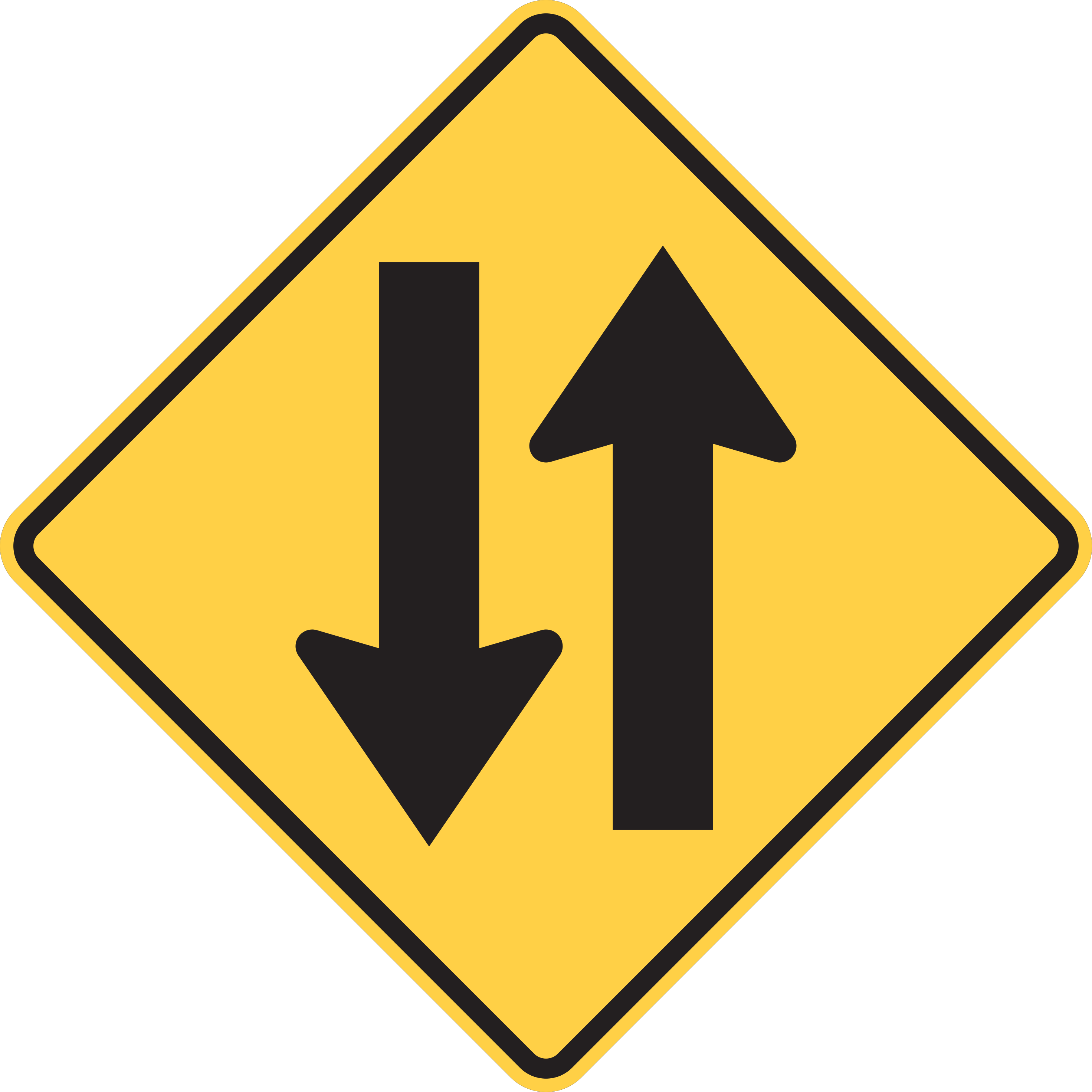
Two-Way Traffic sign
Archive file: W06-03 Two-Way Traffic/W06-03 Two-Way Traffic 30x30.svg
FHWA public-use information
What it means
Expect traffic traveling toward you after the roadway transition.
Source: FHWA MUTCD — MUTCD 11th Edition with Revision 1 (December 2025), Section 2C.51, paragraph 01, PDF page 230.
.
Meaning
Two-Way Traffic warns of opposing vehicle movements on the same roadway. Pennsylvania uses it when a one-way road ends and traffic begins moving in both directions. It may also repeat along an existing two-way section.
What to do
Hold your lane on the right side of the centerline. Watch for vehicles coming toward you instead of assuming that both sides of the road serve your direction.
Where it is used
The warning can accompany the transition from a divided highway or where a one-way street becomes a road carrying opposing traffic. The federal manual also permits repeat signs along the two-way section, so it is not limited to a single transition point.
A sign to tell apart
Divided Highway Ends specifically warns that physical separation is ending. Two-Way Traffic emphasizes the opposing directions and can be repeated after the transition. The two signs can therefore appear as part of the same change in roadway arrangement.
Practice with explanations
These are original learning questions based on the cited handbooks. Read each answer and its explanation below.
1. In Pennsylvania, what does Two-Way Traffic Ahead mean after a one-way road?
- The next section is closed to oncoming vehicles.
- Vehicles will travel in opposing directions on the next roadway.
- Both lanes will continue in your direction.
Answer: B. Vehicles will travel in opposing directions on the next roadway.
The warning identifies the change from one-way to opposing traffic.
2. Where should you position your vehicle after Pennsylvania’s Two-Way Traffic warning?
- Across the centerline until an oncoming car appears.
- On the left half of the roadway.
- In your lane, right of the centerline.
Answer: C. In your lane, right of the centerline.
The handbook directs drivers to stay right of the centerline on the two-way road.
State source coverage
Handbook coverage and sample questions do not prove that a sign will appear on your exam. Even a published test scope cannot guarantee an individual exam question.
Pennsylvania
Handbook coverage
PennDOT explains Two-Way Traffic Ahead and notes repeat use along the roadway. This documents handbook coverage, without promising selection on an individual exam.
- PA-en · Chapter 2 — Warning signs — Two-way traffic ahead · PDF page 19 · Checked
- PA-en · Chapter 2 — Warning signs — Two-way traffic ahead · PDF page 19 · Checked
Pennsylvania permit sources · Practice with Pennsylvania questions
State variations
State-specific variations have not been independently established for this study.
Verified question coverage
These free state-bank questions were independently verified. This does not establish complete state-bank readiness, app availability or what will appear on your permit exam.
California
1 free question uses this sign in Steerlet's verified question data.
California permit sources · General California permit practice (does not include this sign)
The linked 20-question permit quizzes do not currently include this sign.
This meaning is a federal MUTCD reference. Check your state's handbook for its rules and sign coverage; this page does not establish what appears on a state permit exam.
Try the free road sign quiz or find your state's handbook.