Warning signs · W14-2
No Outlet sign
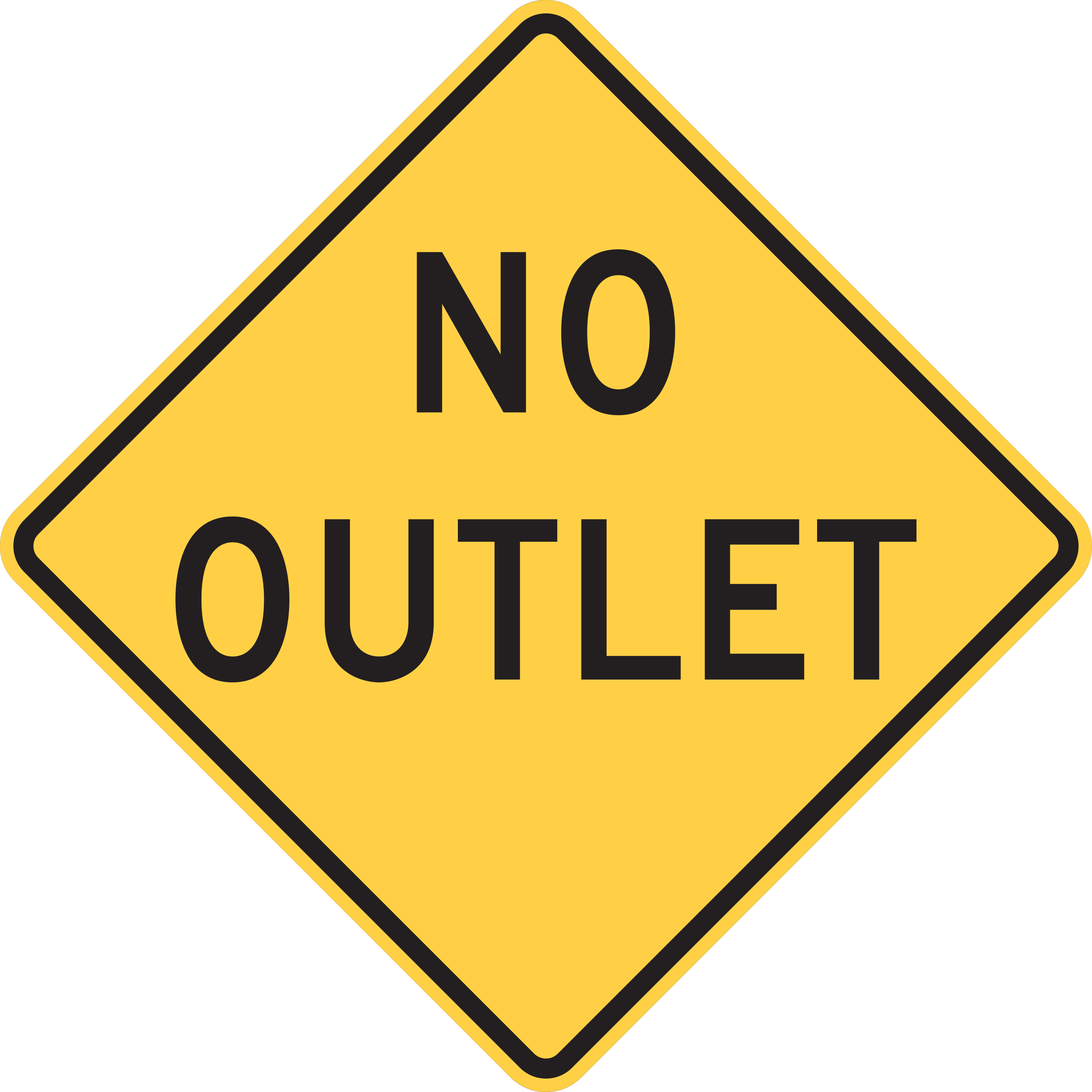
Archive file: W14-02 No Outlet/W14-02 No Outlet 30x30.svg
FHWA public-use information
What it means
The road or road network has no other exit.
Source: FHWA MUTCD — MUTCD 11th Edition with Revision 1 (December 2025), Section 2C.24, paragraph 01, PDF page 212.
.
Meaning
No Outlet warns that a road, or the connected streets beyond it, has no other exit. You may encounter internal intersections after entering. Those connections do not make the area a through route.
What to do
Use the warning before committing to the street network. If your trip requires an exit on the other side, choose another route at an available intersection.
Where it is used
The warning belongs near the entrance or far enough in advance for a driver to take the nearest intersecting street. Its purpose is to make the lack of a through connection clear before the driver enters.
A sign to tell apart
Dead End applies to a single terminating street. Alabama’s handbook uses that warning for a street with no outlet. The federal No Outlet sign also covers a network whose streets connect internally but offer no second exit.
Practice with explanations
These are original learning questions based on the cited handbooks. Read each answer and its explanation below.
1. Alabama explains Dead End as a street without an outlet. What broader situation can the federal No Outlet warning cover?
- A lane that is closed while the other lanes stay open.
- A road that becomes divided by a median.
- Several connected streets with only their entrance as an exit.
Answer: C. Several connected streets with only their entrance as an exit.
The federal distinction allows No Outlet to describe an entire street network.
2. You need a through route and see No Outlet before entering a street network. How should you use that warning?
- Choose another connecting route before entering the network.
- Enter because internal intersections guarantee a second exit.
- Treat the warning as a passing restriction only.
Answer: A. Choose another connecting route before entering the network.
Like the terminating street described by Alabama’s Dead End warning, this network cannot carry you through to a different exit. Advance placement helps you choose another road.
State source coverage
Handbook coverage and sample questions do not prove that a sign will appear on your exam. Even a published test scope cannot guarantee an individual exam question.
No state test-scope claim is independently approved for this study.
State variations
State-specific variations have not been independently established for this study.
Verified question coverage
These free state-bank questions were independently verified. This does not establish complete state-bank readiness, app availability or what will appear on your permit exam.
No currently verified state-bank question is available for this sign.
The linked 20-question permit quizzes do not currently include this sign.
This meaning is a federal MUTCD reference. Check your state's handbook for its rules and sign coverage; this page does not establish what appears on a state permit exam.
Try the free road sign quiz or find your state's handbook.