Regulatory signs · R6-1
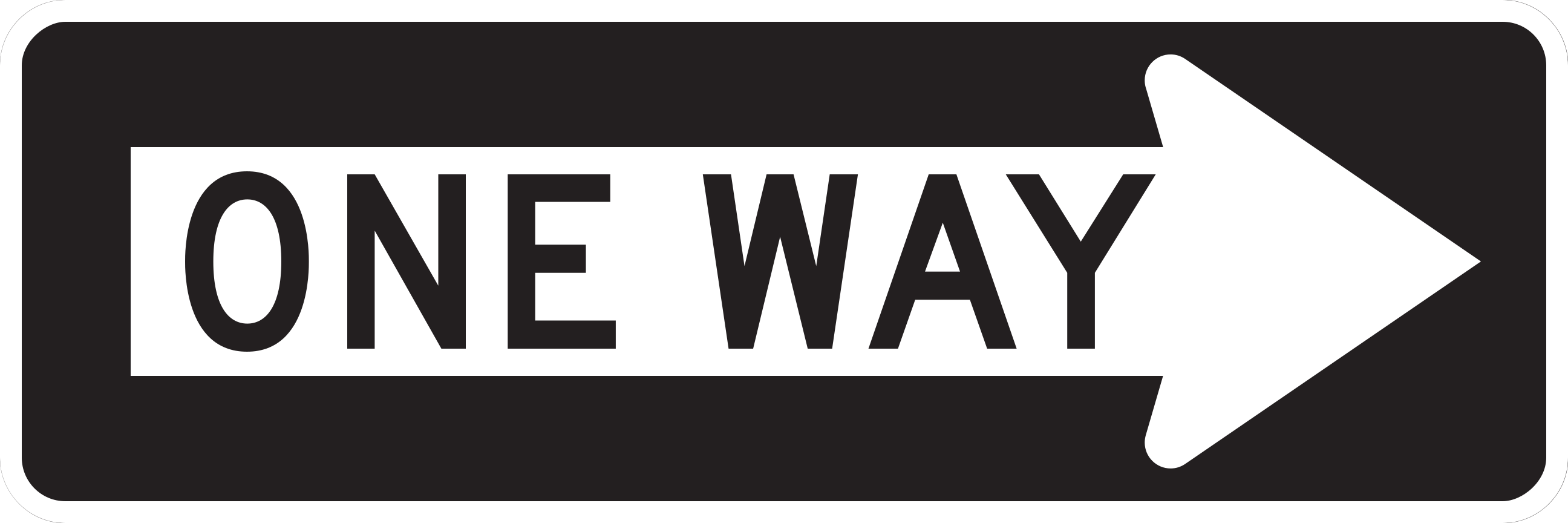
One Way sign
Archive file: R06-01 One Way/R06-01R One Way 36x12.svg
FHWA public-use information
What it means
Vehicles may travel only in the arrow's direction.
Source: FHWA MUTCD — MUTCD 11th Edition with Revision 1 (December 2025), Section 2B.49, paragraph 01, PDF page 155.
.
Meaning
One Way identifies a road where vehicles travel in the direction shown by the arrow. It is a traffic-flow restriction, rather than a warning that the road bends. Driving into that street against the arrow puts you in conflict with vehicles coming toward you.
What to do
Before turning onto a Pennsylvania one-way street, check the arrow and choose the direction it permits. Do not turn against it even if the nearest part of the street looks empty. The handbook identifies the risk as a collision with vehicles traveling in the permitted direction.
Where it is used
Federal standards place One Way parallel to the street it describes, where intersecting roads and alleys join it. At intersections, the location and orientation help you identify the cross street’s permitted flow before you turn. Read which road the arrow belongs to, rather than assuming it describes your present lane.
A sign to tell apart
Keep Right tells you to pass an island or obstruction on its right side. One Way tells you the permitted flow along a road. An arrow on either sign helps direct traffic, but passing the correct side of an island and choosing the correct street direction are separate tasks.
Practice with explanations
These are original learning questions based on the cited handbooks. Read each answer and its explanation below.
1. How must traffic move on a Pennsylvania street marked One Way?
- In either direction when traffic is light.
- Only toward the nearest intersection.
- In the direction indicated by the arrow.
Answer: C. In the direction indicated by the arrow.
The arrow identifies the permitted direction along that street. Opposing movement creates a head-on conflict.
2. A Pennsylvania one-way street is empty, but your planned turn would take you against its arrow. Is that turn permitted?
- Yes, if you stop first.
- No; the street’s direction still applies.
- Yes, until you meet another vehicle.
Answer: B. No; the street’s direction still applies.
The restriction does not depend on whether another vehicle is currently visible. Enter only in the permitted direction.
State source coverage
Handbook coverage and sample questions do not prove that a sign will appear on your exam. Even a published test scope cannot guarantee an individual exam question.
Pennsylvania
Handbook coverage
PennDOT explains this sign in its Pennsylvania Driver’s Manual. This is handbook coverage; it does not establish that this particular sign will appear on your Knowledge Test.
Pennsylvania permit sources · Practice with Pennsylvania questions
State variations
State-specific variations have not been independently established for this study.
Verified question coverage
These free state-bank questions were independently verified. This does not establish complete state-bank readiness, app availability or what will appear on your permit exam.
California
1 free question uses this sign in Steerlet's verified question data.
California permit sources · General California permit practice (does not include this sign)
The linked 20-question permit quizzes do not currently include this sign.
Practice this sign in the federal 20-sign quiz. That tool uses MUTCD questions and is separate from the state-bank questions listed here.
This meaning is a federal MUTCD reference. Check your state's handbook for its rules and sign coverage; this page does not establish what appears on a state permit exam.
Try the free road sign quiz or find your state's handbook.