Warning signs · W8-7
Loose Gravel sign
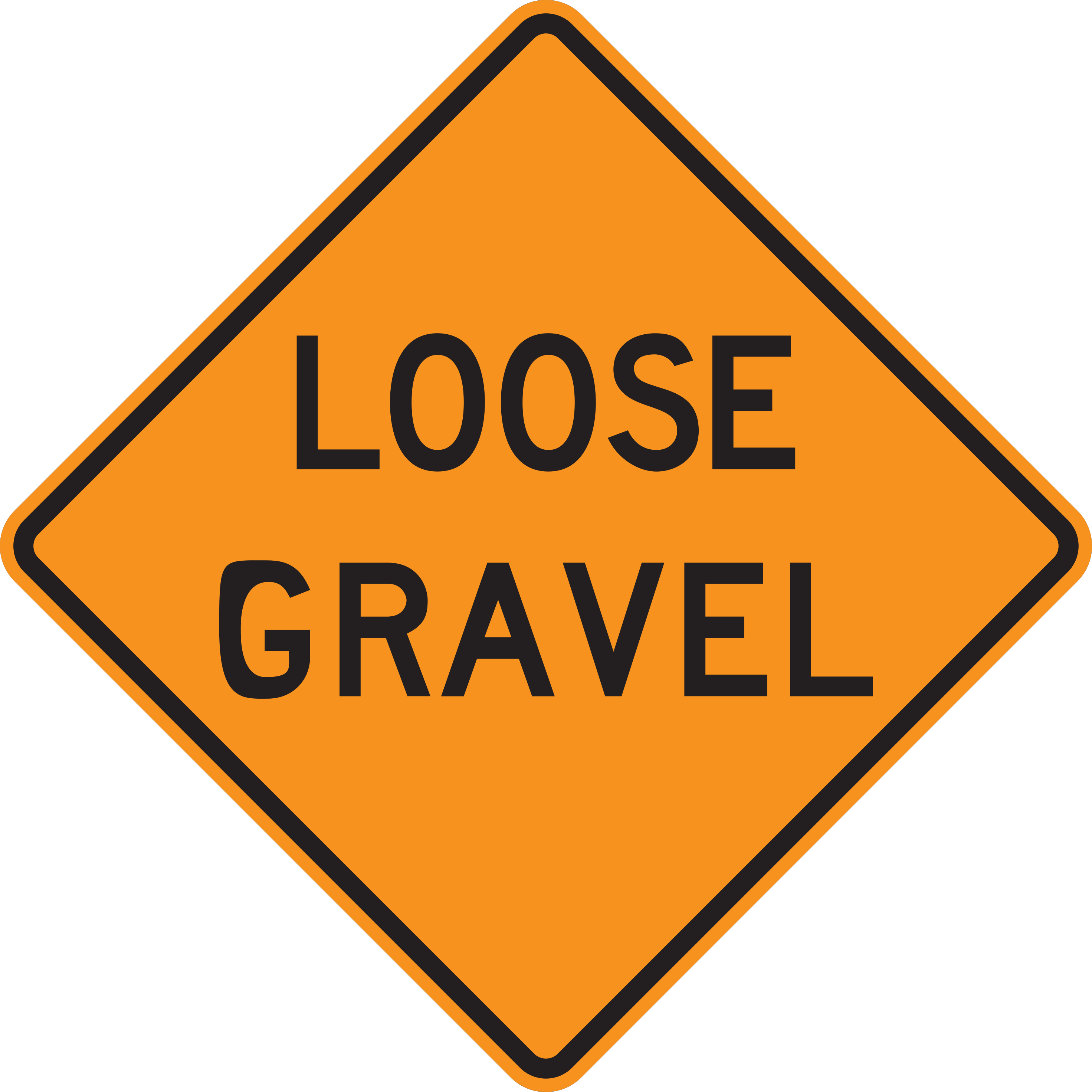
Archive file: W08-07 Loose Gravel/W08-07 Loose Gravel 30x30.svg
FHWA public-use information
What it means
Loose stones cover the road surface ahead.
Source: FHWA MUTCD — MUTCD 11th Edition with Revision 1 (December 2025), Section 2C.30, paragraph 02, PDF page 216.
.
Meaning
Loose Gravel warns that loose material lies on the roadway surface. It identifies the surface condition rather than a required change of direction. Kansas explains why gravel matters: tires have less traction than on concrete or asphalt.
What to do
Reduce speed and allow more room behind the vehicle ahead. Kansas ties both adjustments to the longer stopping distance that comes with reduced traction on gravel or dirt.
Where it is used
Federal guidance puts surface-condition warnings before the affected section. Additional signs can repeat along the road where the condition continues, so the material may extend beyond the signpost.
A sign to tell apart
Grooved Pavement describes a textured roadway surface. Loose Gravel describes loose particles on the road. The federal manual separates these conditions even though either may require extra care around motorcycles.
- Official source · MUTCD 11th Edition with Revision 1 — Section 2C.30, paragraph 02 · PDF page 216 · Checked
- Official source · MUTCD 11th Edition with Revision 1 — Section 2C.31, paragraph 02 · PDF page 216 · Checked
- Official source · MUTCD 11th Edition with Revision 1 — Section 2C.31, paragraph 01 · PDF page 216 · Checked
Practice with explanations
These are original learning questions based on the cited handbooks. Read each answer and its explanation below.
1. Kansas describes reduced traction on gravel. What adjustment should you make on that surface?
- Drive at the same speed and follow more closely.
- Drive slower and leave a larger following gap.
- Drive faster and leave the same following gap.
Answer: B. Drive slower and leave a larger following gap.
Less traction makes stopping take longer, so speed and spacing both need adjustment.
2. Why does Kansas advise a larger following gap on gravel than on a paved road?
- Gravel guarantees that every vehicle will stop sooner.
- Following distance matters only on wet pavement.
- Reduced traction makes the stopping distance longer.
Answer: C. Reduced traction makes the stopping distance longer.
The handbook connects the increased gap to the surface’s lower traction.
State source coverage
Handbook coverage and sample questions do not prove that a sign will appear on your exam. Even a published test scope cannot guarantee an individual exam question.
No state test-scope claim is independently approved for this study.
State variations
State-specific variations have not been independently established for this study.
Verified question coverage
These free state-bank questions were independently verified. This does not establish complete state-bank readiness, app availability or what will appear on your permit exam.
No currently verified state-bank question is available for this sign.
The linked 20-question permit quizzes do not currently include this sign.
This meaning is a federal MUTCD reference. Check your state's handbook for its rules and sign coverage; this page does not establish what appears on a state permit exam.
Try the free road sign quiz or find your state's handbook.